OMNI AIRCRAFT SALES MARKET INSIGHT
Challenger 350 vs. G280: Which Super-Midsize Actually Fits Your Mission?
June 2026
In the super-midsize market, few comparisons come up more often than the Bombardier Challenger 350 and the Gulfstream G280. On paper, the two are remarkably close — similar operating economics, similar mission capability, similar passenger capacity, similar engine pedigree. Most spec-sheet comparisons split the difference and leave the buyer no better off.
At Omni Aircraft Sales, we rarely see this decision come down to a single performance number. The better aircraft is the one that aligns with how the airplane will actually be used, who flies in it, the timing of the acquisition, and the realities of the current market. Right now, the market dynamics behind these two aircraft are very different — and those differences matter just as much as the airplanes themselves.
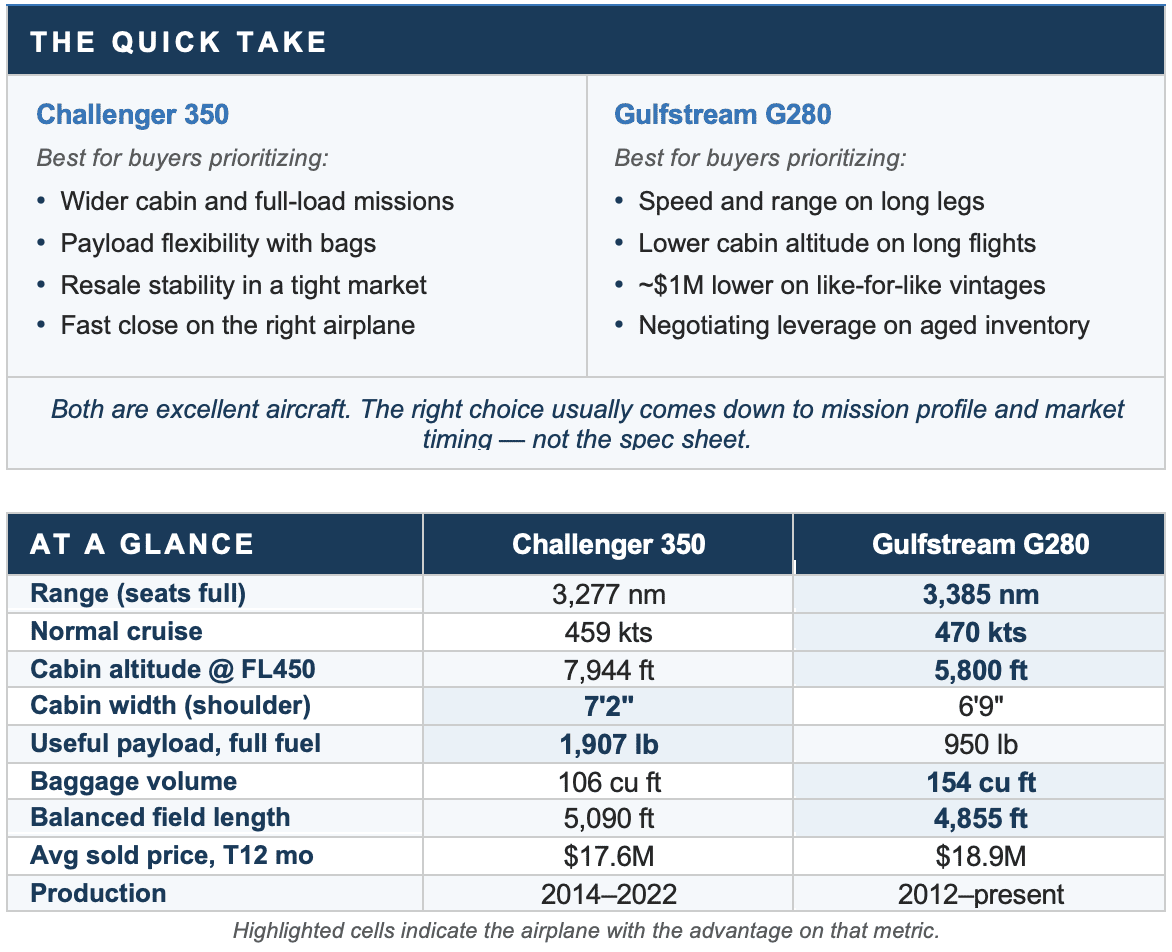
The Gulfstream G280 is the more performance-oriented airplane. Compared to the Challenger 350, it cruises about 11 knots faster, carries roughly 108 nm more seats-full range, climbs to FL430 three minutes quicker, and gets airborne in 235 fewer feet of balanced field. Its pressurization is also notably stronger — at FL450, the G280 holds a 5,800-ft cabin altitude versus the CL350’s 7,944 ft. That cabin-altitude difference is meaningful on a five-hour leg, particularly for older passengers or anyone with cardiovascular sensitivity.
For operators flying coast-to-coast missions with four to six passengers, or running back-to-back travel days, the G280 starts to separate itself.
The Challenger 350 succeeds in a different way. The cabin is wider (7’2″ versus 6’9″ at the shoulder) with a flat-floor design that reads as more open in person. Just as important, it carries roughly 950 lb more useful load with full fuel — meaning it can put eight passengers and their bags in the airplane without trading fuel for payload. Operators flying full cabins, family missions, golf trips, ski trips, or baggage-heavy operations consistently gravitate toward the CL350 for exactly this reason.
The airplane simply feels easier to live with operationally when the cabin is full.
Hourly operating cost between the two airplanes is nearly identical — about $4,841 for the CL350 versus $4,821 for the G280, with annual fixed costs of roughly $820,000 on either side. Fuel burn, crew, and maintenance all land within a narrow range.
Where the economics actually separate is capital cost. Trailing-twelve-month sales tell a more nuanced story than asking prices suggest. CL350 sold prices ranged from $15.0M to $21.6M (mean $17.6M, median $16.7M). G280 sold prices ranged from $12.0M to $27.5M (mean $18.9M, median $17.3M) — but that range reflects a broader vintage mix, including several 2022–2025 aircraft. On a like-for-like 2014–2018 comparison, the G280 still trades roughly $1M below the CL350. The capital-cost gap is real, but smaller than headline asking prices imply, and meaningful only on aged inventory where motivated sellers are negotiating.
This is where the two airplanes are telling very different stories in mid-2026.
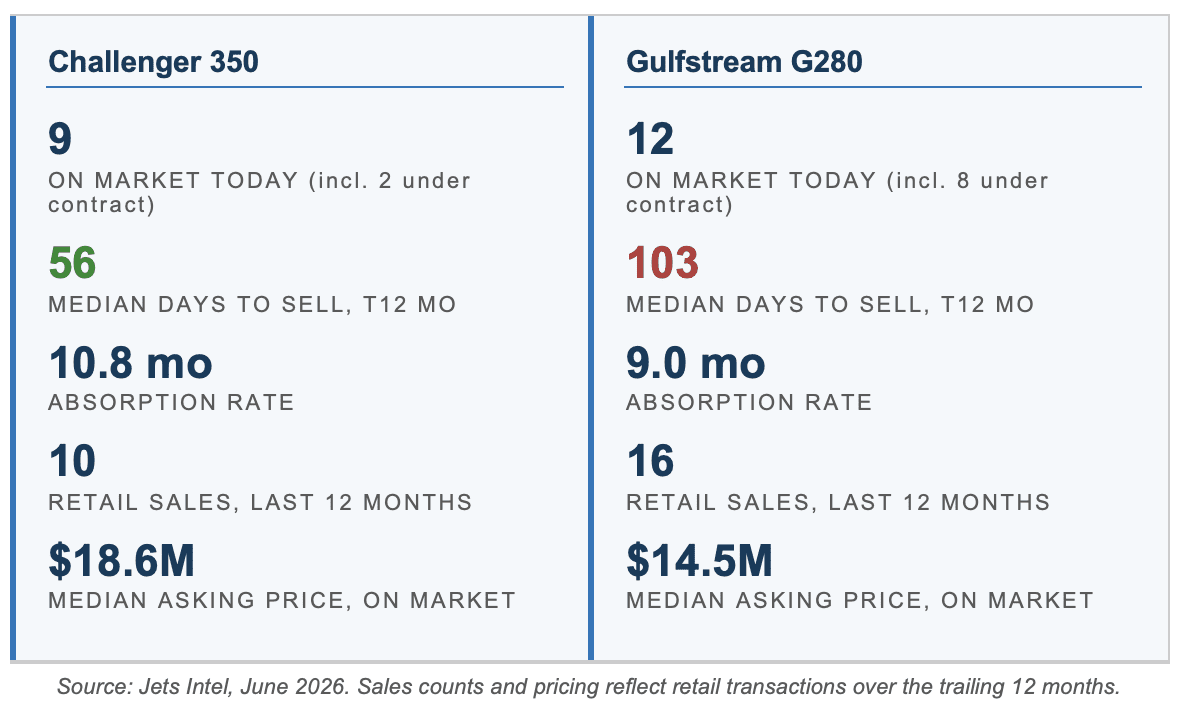
The Challenger 350 market is tight. Inventory is limited — nine total listings worldwide, with two already under contract, leaving seven genuinely available aircraft. More than half of recent sales closed within their first 60 days; well-positioned CL350s continue to clear the market quickly. Production ended in 2022, and the fractional fleet absorbs a meaningful share of the supply that does come up. Sellers still hold leverage on clean, well-documented aircraft.
The G280 market is more divided. Twelve aircraft are currently listed, with eight already under contract — solid evidence of buyer demand. The leverage story is on aged inventory: three listings sit at 401, 474, and 944 days on market, clear evidence of pricing or condition problems on specific airframes. Gulfstream continues to deliver new G280s into the same channel, and buyers willing to engage with aged aircraft find real negotiating room. Well-positioned recent listings, however, are clearing at a comparable pace to the CL350.
On aged G280 inventory, buyers have meaningful leverage. On clean recent listings of either airframe, sellers still hold the cards.
In our experience, the gap between a well-managed CL350 or G280 and a deferred-maintenance example is often larger than the gap between the two models themselves. That gap is where acquisitions create or destroy value — and it is where most brokers stop adding information.
Omni Aircraft Sales works alongside our affiliated Part 145 repair station, Omni Aircraft Maintenance. That partnership gives buyers something most brokers cannot deliver: real inspection-and-maintenance depth at the point of acquisition. We evaluate engine program enrollment, position in the 96-month inspection cycle, deferred-maintenance exposure, avionics currency, and refurbishment economics with the same eye we’d bring to one of our own ownership decisions.
We benchmark every acquisition against real-world sold comps — not optimistic asking prices — and we structure offers that protect downside on the airframe-specific risks that most often surprise buyers after closing.
Before choosing between a Challenger 350 and a G280, we encourage buyers to work through five questions. These are the questions that, in our experience, actually decide the acquisition.
QUESTION 1
How do you actually fly?
Full-cabin, baggage-heavy missions point toward the Challenger 350. Lighter loads on longer legs typically favor the G280. Pull two years of real flight data before you decide; the typical leg and the 90th-percentile leg matter more than the brochure mission.
QUESTION 2
What will your principals actually notice?
Some passengers care about cabin width and the feel of a wider, flat-floor interior. Others notice cabin altitude and fatigue after a five-hour leg. Both matter — but they point to different airplanes. If your principals haven’t sat in both, that is the first thing to fix.
QUESTION 3
Are you buying an airplane, or buying market timing?
Both markets are absorbing inventory at a similar pace — roughly 9 to 11 months — but the texture differs. The CL350 has fewer aged listings and a tighter median time-to-sell, so well-positioned aircraft move fast. The G280 has more buyer-friendly tail inventory — three airframes have been on market over a year. Your timeline to close, and your tolerance for patience in the search, often determine which model is the better acquisition value at a specific moment.
QUESTION 4
What matters more — operating flexibility or acquisition cost?
The CL350 wins on payload flexibility and full-cabin missions. The G280 typically wins on upfront capital efficiency, with a modest acquisition delta on like-for-like vintages and meaningful negotiating room on aged inventory. Hold horizon shapes the answer: short holds weight resale dynamics; long holds weight mission fit.
QUESTION 5
Are you evaluating the aircraft, or the specific airframe?
Inspection positioning, engine program enrollment, deferred maintenance, refurbishment history, and connectivity equipage often matter more than model selection itself. The right model bought as the wrong airframe is a worse outcome than the other way around.
If you are evaluating a Challenger 350, G280, or other super-midsize acquisition, Omni Aircraft Sales would be glad to share live market comps, recent transaction trends, and acquisition strategy specific to your mission profile.
Sources: Jets Intel market data (June 2026), Conklin & de Decker Aircraft Operating Cost and Performance Guide (V 26.1), and Omni Aircraft Sales market intelligence. All figures are estimates for comparison and are not a substitute for an aircraft-specific analysis.